This function calculates the contingency required for a project based on the results of a Monte Carlo simulation. The contingency is determined by the difference between the specified high percentile (phigh) and the base percentile (pbase) of the total project duration distribution.
References
Damnjanovic, Ivan, and Kenneth Reinschmidt. Data analytics for engineering and construction project risk management. No. 172534. Cham, Switzerland: Springer, 2020.
Examples
# Set the number os simulations and the task distributions for a toy project.
num_sims <- 10000
task_dists <- list(
  list(type = "normal", mean = 10, sd = 2), # Task A: Normal distribution
  list(type = "triangular", a = 5, b = 10, c = 15), # Task B: Triangular distribution
  list(type = "uniform", min = 8, max = 12) # Task C: Uniform distribution
)

# Set the correlation matrix for the correlations between tasks.
cor_mat <- matrix(c(
  1, 0.5, 0.3,
  0.5, 1, 0.4,
  0.3, 0.4, 1
), nrow = 3, byrow = TRUE)

# Run the Monte Carlo simulation.
results <- mcs(num_sims, task_dists, cor_mat)

# Calculate the contingency and print the results.
contingency <- contingency(results, phigh = 0.95, pbase = 0.50)
cat("Contingency based on 95th percentile and 50th percentile:", contingency)
#> Contingency based on 95th percentile and 50th percentile: 6.850275

# Without correlation matrix
results_indep <- mcs(num_sims, task_dists)
contingency_indep <- contingency(results_indep,
  phigh = 0.95,
  pbase = 0.50
)
cat("Contingency based on 95th percentile and 50th percentile (
independent tasks):", contingency_indep)
#> Contingency based on 95th percentile and 50th percentile (
#> independent tasks): 4.992183

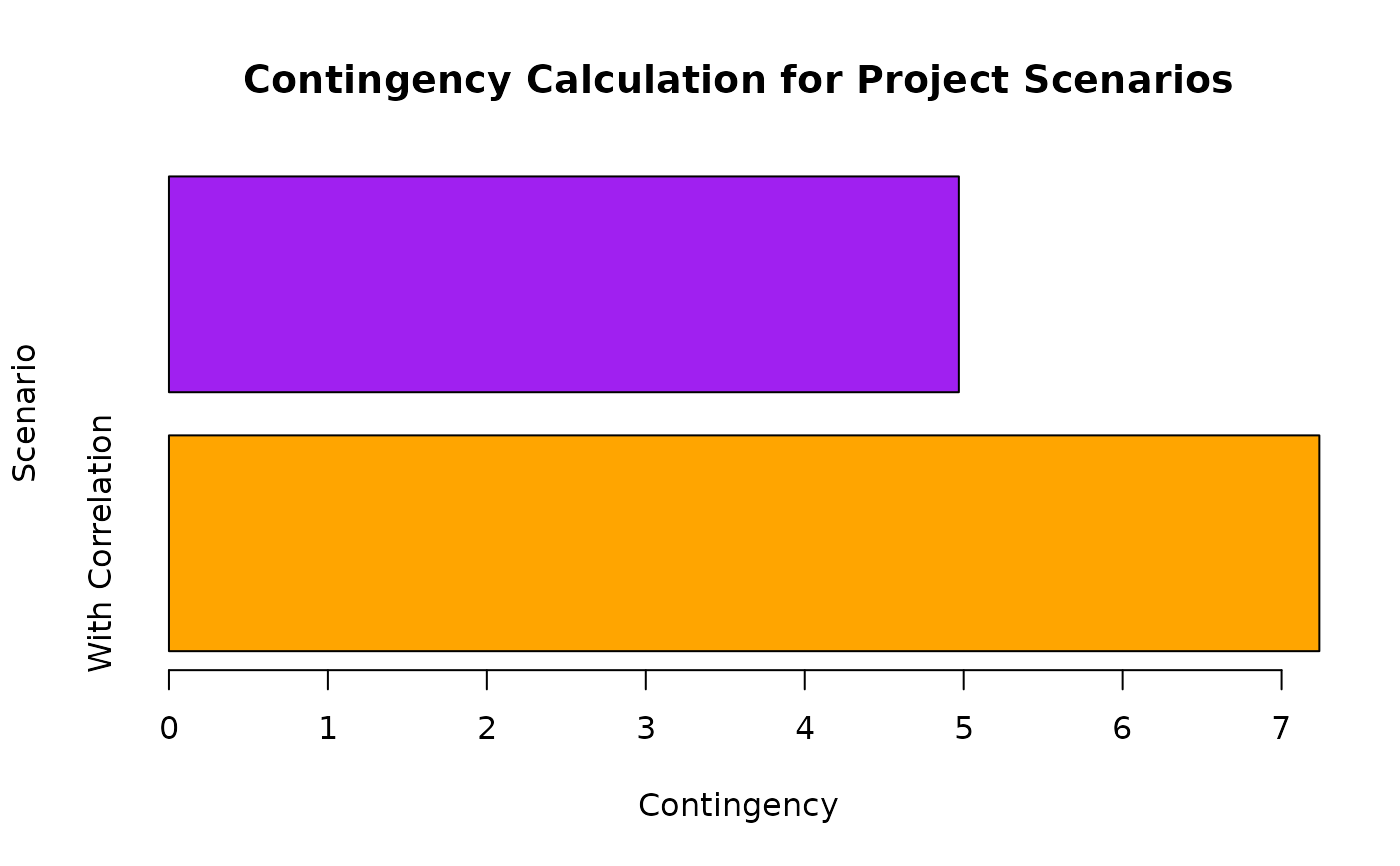
# Build a barplot to visualize the contingency results.
contingency_data <- data.frame(
  Scenario = c("With Correlation", "Independent Tasks"),
  Contingency = c(contingency, contingency_indep)
)
barplot(
  height = contingency_data$Contingency,
  names = contingency_data$Scenario,
  col = c("orange", "purple"),
  horiz = TRUE,
  xlab = "Contingency",
  ylab = "Scenario"
)
title("Contingency Calculation for Project Scenarios")