Project Risk Analysis: A Practical Guide
From Monte Carlo to AI Agents
Preface
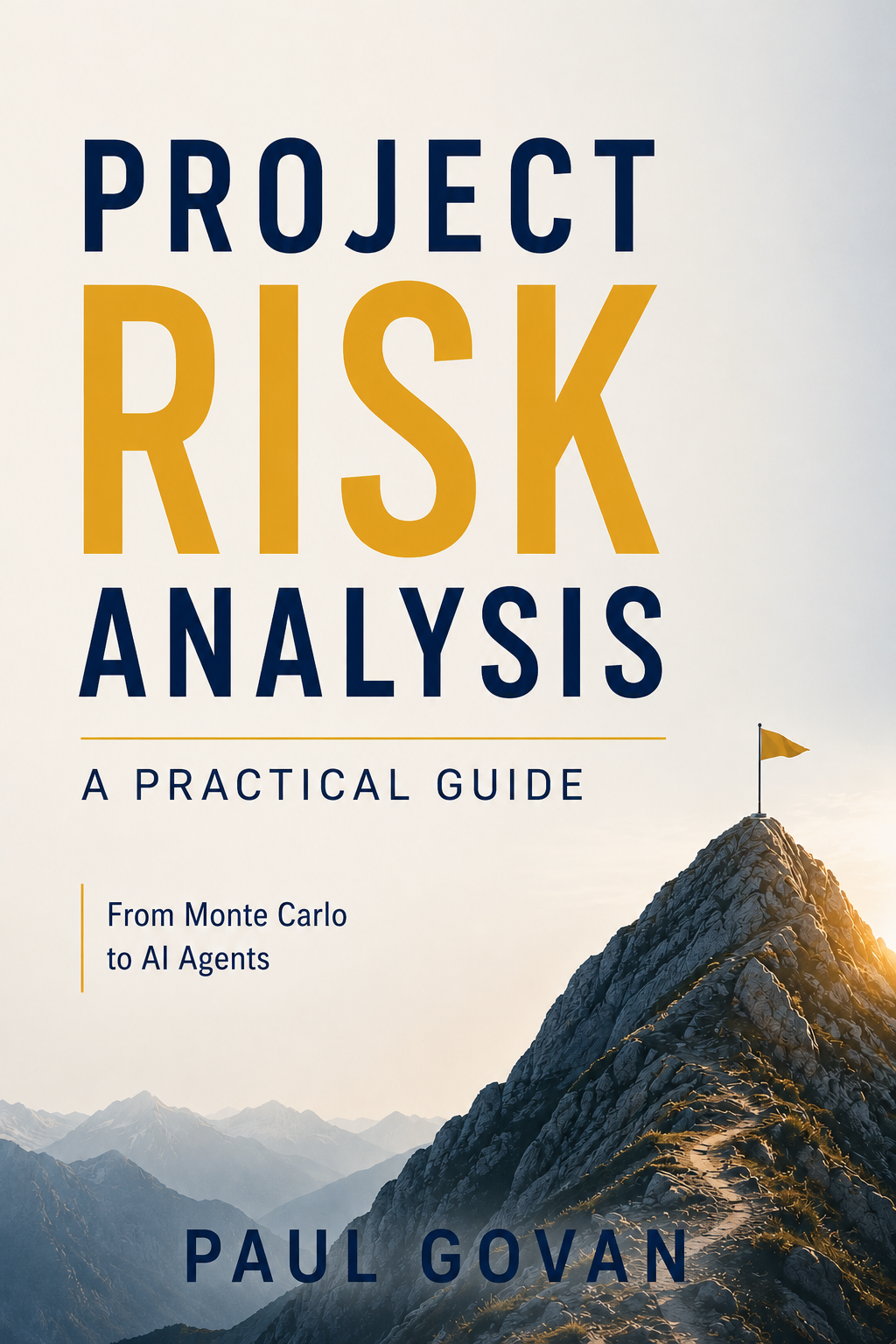
Every project starts with a plan. Then the project starts.
Deadlines shift. Costs drift. Risks that seemed unlikely have a way of becoming very real. Uncertainty is not an edge case in project management, it is woven into the work itself. The question is not whether it will show up, but whether you’ll have the tools to quantify it, communicate it, and manage it thoughtfully.
This book is your toolkit.
What This Book Is About
Project Risk Analysis: A Practical Guide is a hands-on introduction to quantitative methods for managing uncertainty in project schedules and costs. We cover the major techniques used by risk analysts, project managers, and engineers: Monte Carlo simulation, second moment methods, earned value management, Bayesian inference, learning curves, design structure matrices, probabilistic networks, and AI-powered risk analysis, all through working R code using the PRA package.
The goal is not to overwhelm you with theory (though we won’t shy away from the math when it helps). The goal is to give you a real edge: the ability to take a project estimate, ask the right “what if” questions, and produce defensible numbers for schedule and cost contingency.
Who This Book Is For
- Project managers who want to move beyond gut-feel estimates and “10% contingency, because that’s what we always do”
- Engineers and analysts who know statistics but haven’t applied it to project risk
- Students in construction management, systems engineering, or operations research programs
- R users who want practical, well-documented examples of risk analysis workflows
You don’t need to be a statistician to follow along, but you should be comfortable with basic probability (what is a mean? what is a variance?) and have at least a passing familiarity with R.
How to Use This Book
Each chapter is self-contained and covers one method. If you’re in a hurry and just need Monte Carlo simulation, go straight to 2 Roll the Dice: Monte Carlo Simulation. If you already know EVM and want to learn Bayesian inference, skip ahead to 6 I Had a Feeling: Bayesian Risk Inference. That said, the chapters do build on each other conceptually, and reading in order will give you the fullest picture.
Every chapter follows the same structure:
- Why this method?: A short, honest answer to “when would I actually use this?”
- How it works: Just enough theory to understand what the code is doing
- A worked example: Fully reproducible R code from start to finish
- Exercises: Problems that range from “verify you followed along” to “extend this to a real scenario”
Getting Started
All examples use the PRA package. Install it from CRAN:
install.packages("PRA")Or get the development version from GitHub:
# install.packages("remotes")
remotes::install_github("paulgovan/PRA")
Then load it at the start of any session:
library(PRA)Some chapters (especially the network chapters) use additional packages like igraph and networkD3, and the agentic chapter uses ellmer, mcptools, and jsonlite for the MCP server. Prerequisites are listed at the top of each chapter.
A Note on Tone
Risk analysis has a reputation for being dry. Probability tables. Spreadsheets. Earnest diagrams with boxes and arrows. We’ve done our best to keep things lively, with catchy chapter titles, the occasional metaphor, and examples drawn from real project contexts. If a chapter made you smile, that was on purpose. If it also made you understand Bayesian updating, that’s the win.
Why the PRA Package?
Most project risk analysis is done in spreadsheets. Spreadsheets work, until they don’t: a formula breaks, a column gets deleted, and suddenly your P95 estimate is based on a range that ends three rows too early. The PRA package takes the same methods and makes them:
- Tested. Every function ships with a full test suite. You can trust that
mcs()is doing what the documentation says. - Documented. Every parameter has a type, a valid range, and an example. No more guessing what “n” means.
- Reproducible. An R script is a record of exactly what you did. Share it, version-control it, re-run it six months later, and it produces the same result.
- Composable. The output of
mcs()flows directly intocontingency()andsensitivity(). Methods chain together naturally rather than requiring manual copy-paste between tabs.
Learning risk analysis through a software package also enforces discipline: you have to be explicit about your assumptions. Code makes assumptions explicit and verifiable.
A Reproducible Book
Every code block in this book is live. When the book is built, R executes the code and embeds the actual output: the numbers, the plots, the tables. There is no “trust us, this is what you’d see.” If a result looks wrong, you can run the same code yourself and verify it.
This matters because:
- You can experiment. Change a parameter, re-run the chunk, and immediately see how the output shifts. The best way to develop intuition for Monte Carlo simulation is to change the number of samples and watch what happens to the tails.
- The book stays honest. A static book can silently go out of date. A reproducible book will break noisily if a function changes behavior, which means the examples you’re reading have been verified against the current version of
PRA. - You learn a transferable skill. Writing reproducible analyses in Quarto or R Markdown is increasingly expected in data-driven fields. Following along with this book is practice for that.
To reproduce the entire book yourself:
quarto render book/All outputs are generated from scratch in a clean R session.
How to Cite
If you use this book in your work, please cite it as:
Govan, P. (2025). Project Risk Analysis: A Practical Guide: From Monte Carlo to AI Agents. https://github.com/paulgovan/PRA
Or in BibTeX:
@book{govan_pra,
  author    = {Paul Govan},
  title     = {Project Risk Analysis: A Practical Guide},
  subtitle  = {From Monte Carlo to AI Agents},
  year      = {2025},
  url       = {https://github.com/paulgovan/PRA},
  note      = {CC BY 4.0}
}
License
The PRA R package is released under the MIT License. You are free to use, modify, and distribute it, provided the original copyright notice is retained.
This book is released under CC BY 4.0. You are free to share and adapt the material for any purpose, provided you give appropriate credit.
Acknowledgements
The PRA package and this book grew out of research on the resource-based view of project risk management (Govan and Damnjanovic 2016; Govan 2014). Thanks to the open-source R community for the packages that make quantitative risk analysis accessible, and to every project manager who has ever looked at a schedule baseline and wondered whether the numbers were as solid as they looked.
There is only one way to find out: quantitatively.